
1932 Imperial Japanese Army Special Army Maneuvers Medal Participation Badge
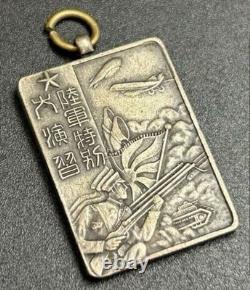
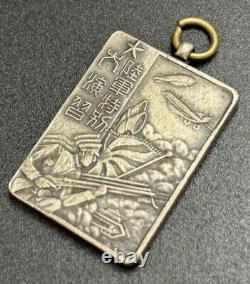
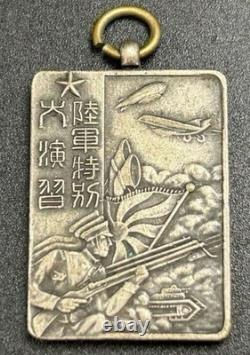
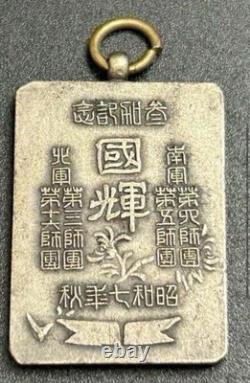

Design motifs: biplane, airship, Rising Sun flag, infantry with bayonet, tank. Symbolizing joint maneuvers of Army, Air, and Mechanized forces. (Southern Army: 5th & 6th Divisions). (Northern Army: 3rd & 16th Divisions). An original commemorative badge issued to participants of the Imperial Japanese Army's annual Special Grand Maneuvers before WWII.
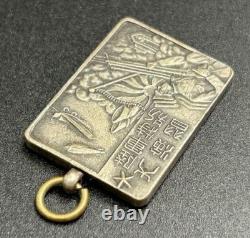
Such pieces were distributed to soldiers, officers, and related participants, making them primary-source memorabilia of official military events. Clearly dated "Autumn, Showa 7" (1932). Inscription shows the maneuver was between Northern Army 3rd & 16th Divs. Vs Southern Army 5th & 6th Divs.
These divisions were stationed in Nagoya, Kyoto, Hiroshima, and Kumamoto - suggesting a Western Japan field exercise. Imperial Japanese Army regular divisions (3rd, 5th, 6th, 16th).
Such maneuvers also involved supporting units-military police, railway regiments, supply and transport, and aviation. In some years, imperial family members and senior officials attended. The 1932 maneuvers took place right after the Manchurian Incident (1931) and around the Shanghai Incident (1932).
Testing nationwide mobilization, logistics, and communications. Showcasing modern combined-arms tactics with aircraft, airships, and tanks. Domestic propaganda: the slogan "Kokko" (National Glory) carved on the back emphasized national prestige.
This badge thus embodies a tense interwar moment when Japan was demonstrating modern warfare capability. Rectangular cast/struck medal with suspension ring. Front shows "land-air-mechanized" collaboration; back lists army group divisions and year. Sized to be worn on a chain or attached to personal effects.Medal only (no case or accessories). Minor age wear, light scratches, and patina consistent with 90+ years. Lettering and motifs remain crisp and fully legible.
A "story-telling" piece: year, divisions, and opposing armies all explicitly inscribed. Design with airship + biplane + tank is especially popular as a symbol of early Showa modernization. Useful for research or display on Japanese division history, city garrisons (Nagoya/Kyoto/Hiroshima/Kumamoto), and the military climate around the Manchurian/Shanghai Incidents.
No political meaning or endorsement is implied. International Buyers - Please Note. Thank you for your understanding.