
1 Pair of Royal Guelphic Order Breast Star Enamel Medal Reproduction
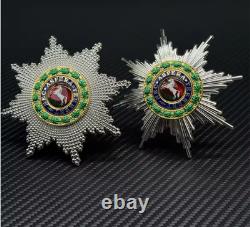
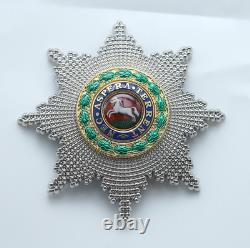
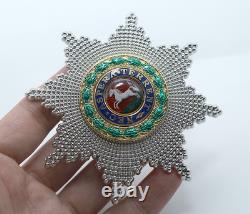

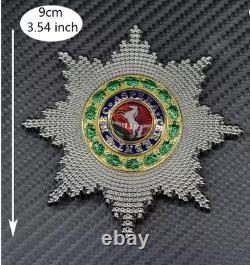
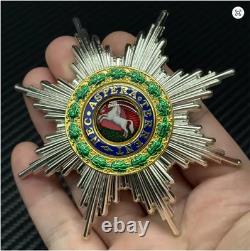
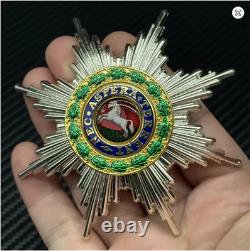

The history of the Breast Star of the Royal Guelphic Order is closely tied to the Kingdom of Hanover and the British Hanoverian dynasty. Below is an English overview. Founder: King George IV of the United Kingdom and Hanover (acting as Prince Regent for his father, George III). Name Origin: Derived from the name of the Hanoverian royal family - the House of Welf (often translated as "Guelph" in English). This dynasty ruled the Electorate (later Kingdom) of Hanover and the British Hanoverian kings.
Purpose: Primarily awarded to subjects of the Kingdom of Hanover in recognition of their loyalty and distinguished service to the monarch and the royal house, especially during and after the Napoleonic Wars. It was essentially a national order of the Kingdom of Hanover.
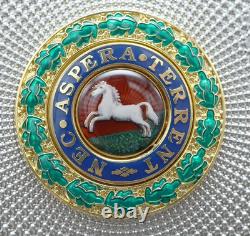
Order Grades and the Breast Star. The Order initially had three grades. Breast Star: A key insignia awarded to members of the Knight Grand Cross (GCH) and Knight Commander (KCH) grades, worn on the left breast. It was a prominent symbol of status and honor within the Order. Typically an octagonal silver star (sometimes with four or more points). Central Medallion: Core motif features the White Horse of Hanover, set against a deep red enamel background, surrounded by a golden oak leaf wreath. Outer Ring: A blue enamel ring bearing the gold motto "NEC ASPERA TERRENT" (meaning "Difficulties do not terrify" or "Undaunted by adversity"), the motto of the Hanoverian dynasty. Above the Medallion: A Royal Crown.The Knight Grand Cross Breast Star was typically larger, more elaborate, and often had more rays (commonly eight) than the Knight Commander star. Key Points in Historical Development.
British subjects (particularly those involved in Hanoverian affairs) were sometimes awarded it, but the primary recipients remained Hanoverians. Critical Turning Point in 1837: Queen Victoria ascended the British throne. According to Hanover's Salic Law (barring female succession), the Hanoverian throne passed to her uncle, Ernest Augustus, Duke of Cumberland, ending the personal union between Britain and Hanover. Change of Affiliation: The Royal Guelphic Order henceforth became a purely Hanoverian order, continued to be awarded by the Kings of Hanover (Ernest Augustus and his son George V).
Abolition of the Order (1866). Austro-Prussian War: The Kingdom of Hanover supported Austria in the 1866 Austro-Prussian War. Outcome: Hanover was defeated and annexed by the Kingdom of Prussia, becoming a Prussian province. Abolition: With the demise of the Kingdom of Hanover, the Royal Guelphic Order as a state order was abolished and ceased to be awarded. Historical Significance and Survival of the Breast Star.
Symbol of Hanoverian Sovereignty: The design elements of the Breast Star (White Horse, Crown, Motto) embodied the national symbols and royal authority of the Kingdom of Hanover. Witness to History: It witnessed the post-Napoleonic European order, the dissolution of the Anglo-Hanoverian union, the process of German unification, and the rise and fall of the Kingdom of Hanover. Collector's Item: Today, the Breast Stars of the Royal Guelphic Order (especially the Grand Cross stars) are highly prized and significant antique orders and royal memorabilia, sought after by collectors and history enthusiasts. They preserve the record of recipients' achievements and that specific historical era. Locations: Besides private collections, notable Breast Stars may be found in museums (such as early British-awarded examples potentially in the Tower of London's Royal Collection), with descendants of the former Hanoverian royal house, or in historical archives.The Breast Star of the Royal Guelphic Order was the honorific insignia for high-ranking members of the national order of the Kingdom of Hanover (the Royal Guelphic Order). It was established in 1815 after the Napoleonic Wars by King George IV of the United Kingdom and Hanover to reward loyalty to the Hanoverian Crown. Following the dissolution of the personal union in 1837, it became a purely Hanoverian order.
With the annexation of the Kingdom of Hanover by Prussia in 1866, the Order and its Breast Star ceased to be awarded. Today, it stands as a valuable artifact and collectible documenting the history of the Kingdom of Hanover and its royal honors, its design (White Horse, Crown, motto "NEC ASPERA TERRENT") being a concentrated expression of Hanoverian sovereignty.