
USA / G. BRIT MEDAL 1736 BETTS-169 JERNEGAN'S LOTTERY with SCHOOL PRIZE ENGRAVING
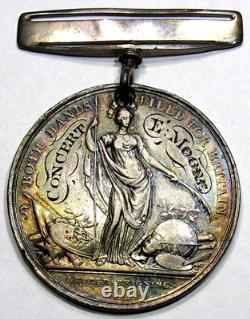
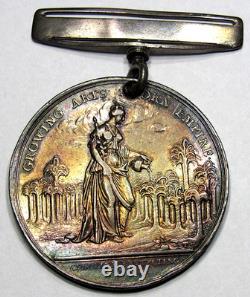

1736 Jernegan's Lottery Prize Medal. Betts-169, DMRC-1, MI-517-72, 39mm, Sterling Silver. Total weight with silver hanger bar: 23.29g. AU55 Details, Holed & Engraved, with silver bar. A stunningly beautiful, uncleaned piece, dripping with glittering luster and bright rainbow toning on each side. Superb in the eye appeal department. The Jernegan's Lottery Prize Medals were superfluous in the mid-18th century, and an occasional piece is found repurposed for use as a school prize medal.
Another school prize medal was struck around this time period showing Minerva in similar pose. It was actually pretty smart to reuse the Jernegan's Lotter medals in similar fashion, as they were said to be.
That said, we cannot prove the date of the post-mint engraving. The mechanics of the bezel suggest late-18th to early 19th-century.
As an antique, it would be appropriate to date this piece as Georgian. " This is an instance where the post-mint "damage does not detract. Engraved" "CONCERT / E: MOORE, with MOORE neatly crossed out with engraving lines. Perhaps the engraver misspelled Moore, or Moore was the wrong name, and this one was a reject. Nearly everything you've heard about Jernegan's medal is wrong, so we will not bore you with the usual story.Attempts to set the record straight. The story was pieced together from nearly 30 newspaper accounts from 1700s Great Britain. Some of the major points include. Henry Jernegan was a London goldsmith who created a huge, baroque style, 7,700 oz, silver wine cistern in 1735.
Unable to sell the monstrous and absurdly expensive vessel, he resorted to a lottery, which ultimately was postponed until November of 1737. Negotiations with Parliament to set up a state lottery that would help him sell the cistern and also. Ran his lottery simultaneously with Parliament's Bridge Lottery, overshadowing the latter, due to more favorable odds of winning in his sale, thanks to thousands of these medals being counted as prizes, among hundreds of other lavish jewels and precious objects. The grand prize was the massive silver wine cistern. The sale was sensational news in Britain. Queen Caroline took ill and died while it was going on, making the medal that was intended to celebrate the empire's thriving colonies-which coincidentally featured her likeness-an extremely prescient and coveted commemorative of a beloved, fallen monarch. However, the medals were not struck until January and February of 1738, and the astronomical number of medals needed to fill the order required Tanner, at the Tower Mint, to engrave no less than three obverse dies and four reverse dies, making a total of five known die marriages.DMRC-1 is the most carefully engraved and detailed of the five, indicating it was likely the original die pair and that the others were fast-tracked. These medals were cherished for many years thereafter, due to their perceived connection to Queen Caroline, and to the subsequent events surrounding the cistern, which were the stuff of tabloid legend as late as the 1760s. Some were repurposed as school prize medals and engraved with awardees names. Despite being tossed into circulation many decades later, after their meaning had been all but forgotten, the medals survive in some quantity today.
Jernegan's medals remain a lasting tribute to Queen Caroline, and the North American colonial empire (featured on the reverse), as they were always intended. Thus, Betts was correct; this medal belongs in the American catalog. It was the British plantation empire in America that was thriving at this time, so much so that. North Carolina had just been carved out of greater Carolina in 1729. Carolina, and especially South Carolina, was the crown jewel of the "growing arts" that did "adorn" the British Empire in 1737. Looking for something out of the ordinary? We scrutinize thousands of PCGS and NGC slabs to provide you with coins that are truly special, and we do it with fast, knowledgeable, and courteous service. Whether you are seeking beautiful color, an exceptional strike; or maybe proof-like luster, a rare die variety, or even CAC verification; we have something for everyone. The Photographs seen here are compliments of DM Rare Coins Coin Photography Service!